This is the whole thing
No dashboard to learn. The dock sees one big button; the office sees a sealed record it can send to anyone.
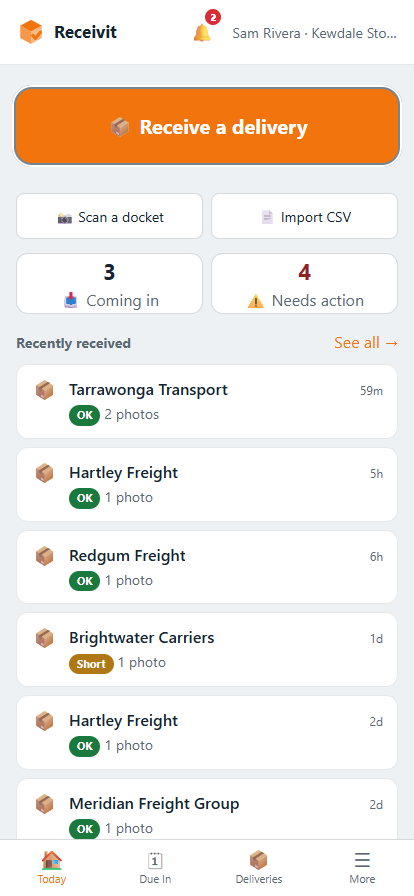
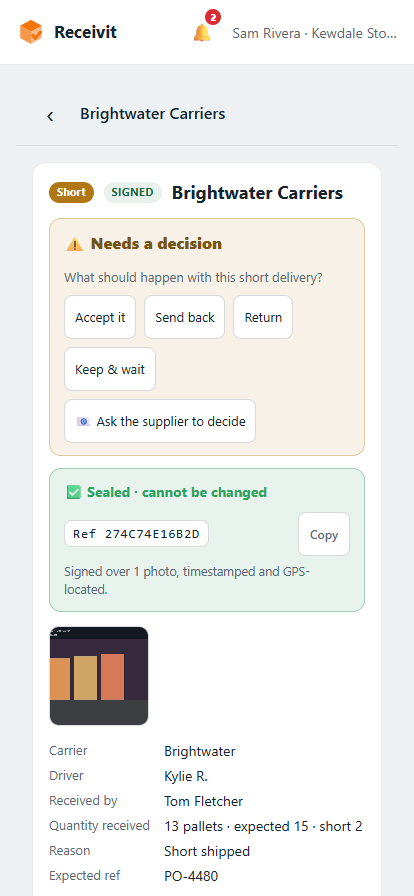
Screens from a demonstration account. Businesses and deliveries shown are fictional.
Built for the receiving end
When a pallet arrives short, damaged, or not at all, the argument comes down to who can prove what. Receivit gives your dock staff a thirty-second capture — photos, condition, who signed — and seals it so it can't be edited after the fact. Including by you.
Works on any phone. No app store, no hardware, no install.
Goods-inwards is where margin quietly leaks. Not on the deliveries that go fine — on the handful each month that don't, where nobody can say exactly what arrived.
Short-shipped stock turns into a phone argument three weeks later, with a docket nobody can find and a driver nobody can name. Usually you wear it.
Someone took a picture of the damage. It's on their phone, they've left, and it has no timestamp anyone would accept anyway.
A scrawl on a paper docket says something was delivered. It doesn't say what condition it was in, or how many of them there were.
Big buttons and no training — quick enough to do on every delivery, not just the ones that go wrong.
Snap the goods and the docket. Scan a barcode if there is one, or photograph the run sheet and Receivit reads the deliveries off it — you check them before anything is created.
OK, short, or damaged. If something's wrong, pick the reason and say what — short shipped, damaged in transit, wrong item, refused at the dock. That's the record that matters later.
Signed for, left under authority to leave, refused, or verified by a code the customer shows. Driver name, GPS, time. Then it seals — and the office gets the receipt PDF by email the moment anything is short, damaged or refused.
No dashboard to learn. The dock sees one big button; the office sees a sealed record it can send to anyone.
Screens from a demonstration account. Businesses and deliveries shown are fictional.
Every record is hashed and chained to the one before it. Change so much as a digit in an old entry and the chain breaks — visibly, permanently, and in a way anyone can check. That includes us, and it includes you. A record you could quietly edit is worth nothing in a dispute; that's the entire point.
Capturing evidence is only useful if it reaches the person who can act on it.
Send a supplier a link to the sealed delivery. They see exactly what you saw — photos, condition, time — and respond on the record instead of over the phone. Short and damaged deliveries get a two-party decision, not a stalemate.
Import what's due from a spreadsheet, or read it off a photo of the run sheet. The dock sees what's coming, the office sees what hasn't landed, and the details auto-fill when it arrives.
Which supplier is short-shipping you, how often, and by how much — by week, by month, by supplier. The conversation you couldn't have before.
Push every sealed delivery straight into your inventory or accounting system by webhook, with a signed key so it can verify the update genuinely came from us.
No per-seat maths, no counting drivers. If they work for you, they're on it.
Australian dollars. Cancel any time.
No. It runs in the phone's browser and can be added to the home screen like an app. Nothing from an app store, nothing to update, and it works on whatever handset they already have.
The capture is saved on the phone and uploads when signal returns. The driver sees what's still waiting to go up, and can retry it themselves.
No — and that's deliberate. Corrections are added as visible entries alongside the original, never in place of it. If the original could be edited, the record would be worthless the moment anyone disputed it.
Delivery records are hosted in Australia, in Sydney. Our privacy policy names every provider we use and says plainly which of them process anything outside Australia.
Receiving, primarily — it's built for the goods-inwards end, where the evidence usually isn't captured. You can record pickups and outgoing shipments too, and connect with businesses you regularly send to or receive from.
It's aimed at operations running a handful of vehicles or a busy dock — enough deliveries that the disputed ones add up, not so many that you already have a warehouse system. If you get one bad delivery a year, you don't need this.
Set it up in a few minutes and record your next delivery today.
Set up your business